

Most safety and compliance managers treat regulatory adherence as a legal obligation first and everything else second. That framing is costing companies more than they realize. Why safety compliance protects company reputation is not a soft, secondary concern — it is a direct driver of contract wins, investor confidence, client retention, and talent attraction. In construction, healthcare, logistics, and government contracting, your safety record is visible to everyone who matters. This guide breaks down exactly how compliance shapes reputation, what happens when it fails, and what the best-run organizations do differently to stay ahead.
Table of Contents
- How safety compliance builds trust and a competitive advantage
- The long-term costs of poor safety compliance on reputation
- Why intensified enforcement underscores reputational risk
- Reputation protection through continuous readiness and documentation in healthcare and government sectors
- How fostering a positive safety climate prevents incidents and protects reputation
- The critical role of crisis communications in protecting reputation after safety incidents
- Our perspective: compliance documentation is your most underused reputation asset
- See how ARKVOS turns compliance records into reputation protection
- Frequently asked questions
Key Takeaways
| Point | Details |
|---|---|
| Compliance builds trust | Visible adherence to safety standards signals reliability and professionalism to clients and partners. |
| Noncompliance risks reputation | Safety failures cause lasting damage impacting market position, customer loyalty, and talent attraction. |
| Continuous readiness is vital | Ongoing documentation and safety practices protect reputation and regulatory participation. |
| Safety climate drives behavior | Positive cultures promote compliance and reporting, preventing incidents and underreporting. |
| Crisis communication matters | Clear, timely messaging aligned with compliance reduces reputational losses after incidents. |
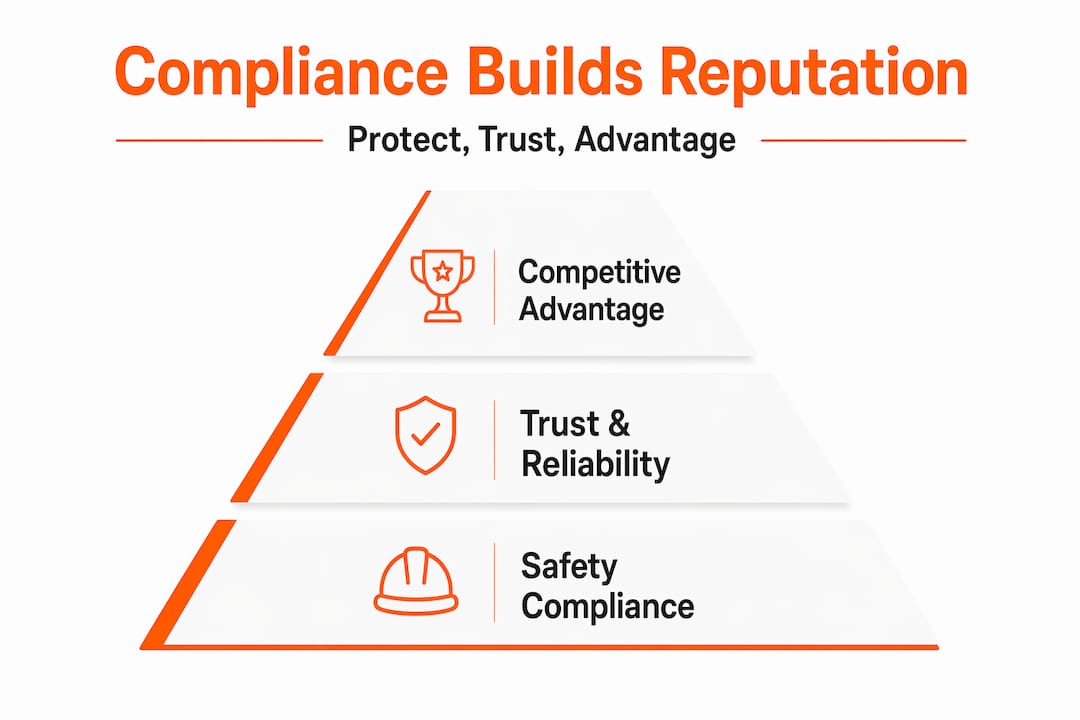
How safety compliance builds trust and a competitive advantage
Safety compliance is not just about avoiding citations. It is a visible signal to every stakeholder who evaluates your organization. Clients, general contractors, hospital systems, and government agencies all conduct pre-qualification reviews before awarding contracts. At that stage, your safety record is not background noise — it is a primary filter.
Clients and partners expect evidence of robust safety practices during procurement and contract bids, making compliance a distinct competitive advantage. Companies with documented safety programs, low incident rates, and audit-ready records move through procurement faster and with fewer objections. Those without them get screened out before the conversation even starts.
Here is what documented compliance actually signals to the market:
- Operational discipline: You run a tight operation. Clients assume that a company managing safety well manages everything well.
- Financial stability: Fewer incidents mean lower workers' compensation costs, fewer project delays, and reduced insurance premiums — all of which make you a lower-risk partner.
- Regulatory credibility: Regulators treat compliant organizations differently. Proactive documentation reduces the likelihood of surprise inspections escalating into citations.
- Talent magnetism: Skilled workers choose employers with strong safety records. High turnover in safety-critical roles is itself a reputational signal.
"A strong safety record is not just about protecting workers — it is a measurable business asset that influences procurement decisions, insurance costs, and long-term brand positioning."
The importance of safety compliance becomes clearest when you compare two otherwise identical bids. Same price, same timeline, same team size. One company has a documented safety management system and a clean OSHA log. The other does not. In regulated sectors, the outcome of that comparison is rarely close.
To appreciate this trust-building role, it is important to understand the severe consequences when compliance fails.
The long-term costs of poor safety compliance on reputation
Reputational damage from safety failures does not arrive all at once and then fade. It compounds. A single serious incident or enforcement action can trigger a cascade of consequences that affect your business for years.

Poor safety compliance leads to enforcement penalties, operational restrictions, and reputational damage impacting market perception, customer loyalty, and talent attraction over years. That is not a worst-case scenario — it is the documented pattern across industries.
Here is how the damage typically unfolds:
- The incident becomes public. OSHA citations are public record. Court filings are public record. News coverage follows enforcement actions, especially in construction fatalities, healthcare violations, and transportation accidents.
- Client relationships freeze. Existing clients pause renewals pending investigation outcomes. Prospective clients remove you from consideration entirely.
- Insurance costs spike. Carriers reprice or cancel coverage. Some organizations face coverage gaps during the period when they need it most.
- Talent exits. Experienced workers and managers leave. Recruiting becomes harder when your safety record is searchable.
- Recovery takes longer than expected. Rebuilding trust with regulators, clients, and the public typically takes three to five years of demonstrated clean performance — not one good quarter.
"The financial cost of a single serious safety violation extends well beyond the fine. The reputational cost, measured in lost contracts and talent, often exceeds the direct penalty by a factor of ten."
The impact of safety on reputation is not abstract. It shows up in bid outcomes, renewal rates, and the caliber of candidates who apply to work for you. Understanding this makes the business case for proactive compliance obvious.
Understanding the risks of noncompliance highlights why enforcement intensity must be addressed proactively.
Why intensified enforcement underscores reputational risk
Regulatory enforcement is not slowing down. OSHA continues active enforcement through citations, emphasis programs, and severe violator enforcement, signaling operational discipline and governance credibility to clients and investors alike. Even without sweeping new regulations, the agency's existing tools are being applied more aggressively.
For logistics and transportation companies, the exposure is even more concentrated. One safety incident can trigger multiple agency investigations simultaneously, increasing reputational exposure far beyond what a single citation would create. A trucking accident, for example, may draw OSHA, DOT, and state labor agencies at the same time — each with its own public record and media footprint.
Here is how enforcement intensity differs across sectors:
| Sector | Primary enforcement body | Reputational amplifier |
|---|---|---|
| Construction | OSHA federal and state plans | Public fatality reports, contractor prequalification databases |
| Healthcare | CMS, state health departments | Medicare/Medicaid participation status, public inspection reports |
| Logistics | DOT, OSHA, state agencies | Multi-agency investigations, CSA scores visible to clients |
| Government contracting | Multiple federal agencies | Contract suspension, debarment proceedings |
The pattern across all four sectors is the same: enforcement actions create public records, and public records shape how clients, partners, and the public perceive your organization. Safety compliance and brand image are inseparable in environments where your regulatory status is searchable.
Key enforcement realities to build your strategy around:
- OSHA's Severe Violator Enforcement Program places companies on a public list that clients actively check.
- State-level enforcement often moves faster than federal and generates local media coverage.
- Repeat citations carry significantly higher penalties and trigger enhanced scrutiny on all future inspections.
This enforcement landscape particularly affects regulated sectors like healthcare, where reputation ties directly to compliance status and funding.
Reputation protection through continuous readiness and documentation in healthcare and government sectors
Healthcare organizations operate under a compliance model that most industries do not fully appreciate: readiness must be continuous, not episodic. CMS Conditions of Participation require continuous safety readiness and documentation to maintain Medicare and Medicaid participation, directly impacting reputation and funding. There is no "compliance season." Surveyors can arrive unannounced, and what they find on any given day is the record.
Immediate Jeopardy findings and continued noncompliance at healthcare facilities threaten both funding and public trust in ways that are extremely difficult to reverse. When a hospital appears on a public noncompliance list, patient volumes drop, physician recruitment suffers, and community confidence erodes — all before any formal penalty is assessed.
What continuous compliance documentation actually looks like in practice:
- Daily attendance and safety check-in records that prove workers were present, trained, and following protocols at the time of any incident.
- Audit trails with timestamps and location data that can be pulled instantly during a survey or investigation.
- Documented corrective action plans that show regulators a pattern of identifying and fixing problems, not hiding them.
- Staff training records tied to specific dates and personnel, not generic completion logs.
For government contractors, the stakes are similar. A compliance failure can trigger suspension from federal contracting, which is effectively a death sentence for companies whose entire revenue depends on government work.
Pro Tip: Do not wait for an audit to discover gaps in your documentation. Run a monthly internal review of your check-in records, training logs, and incident reports. Regulators respond very differently to organizations that identify and correct their own deficiencies versus those that are caught by surveyors.
Beyond healthcare, the organizational climate and employee behavior play a crucial role in reputation through compliance adherence.
How fostering a positive safety climate prevents incidents and protects reputation
A safety program that exists only on paper is not a safety program. It is a liability. The difference between organizations that maintain strong reputations and those that suffer repeated incidents often comes down to whether employees actually participate in safety practices or just tolerate them.
A positive safety climate increases compliance and reduces workplace injuries, directly strengthening trust and reputation with clients, regulators, and the public. When workers believe that management genuinely cares about their safety, they follow protocols more consistently, report hazards earlier, and participate in safety programs rather than working around them.
The opposite dynamic is equally well documented. Fear-driven underreporting undermines compliance programs and creates serious reputational risk when hazards go unaddressed and eventually cause incidents. Workers who fear retaliation for reporting near-misses stay quiet. Those quiet near-misses accumulate into the serious incidents that end up in the news.
Building a safety climate that actually protects reputation requires:
- Management visibility on the floor. Leaders who show up at job sites, hospital units, and loading docks send a signal that safety is not just a policy document.
- No-fault hazard reporting. Workers need to know that identifying a problem earns recognition, not punishment.
- Closed-loop follow-up. When a worker reports a hazard, they need to see it addressed. Silence after a report kills future reporting.
- Consistent accountability at all levels. Safety rules applied only to frontline workers and not to supervisors destroy credibility fast.
Pro Tip: Track your near-miss reporting rate as a leading indicator of safety climate health. A rising near-miss report count is almost always a positive sign — it means workers trust the system enough to use it. A flat or falling count in a large operation is a warning signal worth investigating.
Finally, how an organization communicates during crises can significantly influence reputation outcomes after an incident.
The critical role of crisis communications in protecting reputation after safety incidents
Even organizations with strong compliance programs will eventually face an incident. What separates those that recover quickly from those that suffer lasting damage is rarely the incident itself. It is how they communicate in the hours and days that follow.
Poor crisis communications correlate with severe market-cap losses and a 5:1 ratio of reputational to operational damages. That ratio should stop every compliance manager cold. The incident causes one unit of operational harm. The communications failure causes five units of reputational harm.
Effective crisis communication in safety-regulated industries follows a clear sequence:
- Acknowledge immediately. Silence in the first 24 hours is interpreted as concealment. A brief, factual statement that confirms the incident and commits to transparency is always better than nothing.
- Lead with your compliance record. Your documented safety history is your most credible asset in a crisis. Reference it early and specifically — not vaguely.
- Align your messaging with your documentation. If your records show workers were checked in, trained, and following protocol, say so with specifics. Vague reassurances without evidence are dismissed.
- Correct the narrative before others define it. Regulators, plaintiff attorneys, and media will fill information vacuums. Your job is to provide accurate context before they do.
- Commit to documented corrective action. Announcing a corrective action plan with a timeline and measurable outcomes is far more credible than promising to "do better."
"The organizations that recover fastest from safety incidents are those that can point to a documented compliance record and communicate it clearly. Documentation is not just a regulatory requirement — it is your reputation insurance."
Does compliance improve public perception after an incident? The answer is yes, but only if the compliance record is real, documented, and communicated with specificity.
Our perspective: compliance documentation is your most underused reputation asset
Here is something most safety professionals do not hear enough: your documentation is not just for auditors. It is for every stakeholder who will evaluate your organization during a crisis, a contract bid, or a regulatory review.
The conventional wisdom in compliance circles is that documentation is a burden — a checkbox exercise that consumes time without adding value. That framing is wrong, and it costs organizations dearly. The companies that treat every check-in record, every safety briefing log, and every corrective action report as a reputational asset behave differently. They build systems that generate records automatically, make those records instantly retrievable, and use them proactively in client communications and regulatory interactions.
Safety practices and corporate trust are not built through marketing. They are built through evidence. When a client asks about your safety record, the answer should not be a verbal assurance — it should be a report. When a regulator arrives unannounced, your team should be able to pull complete documentation in minutes, not hours. That speed and specificity communicates more about your organizational discipline than any safety statement ever could.
The organizations that get this right treat compliance documentation the same way finance teams treat financial records: as a core operational asset that requires real investment, real systems, and real accountability. The ones that get it wrong treat documentation as paperwork. The difference shows up in contract wins, regulatory relationships, and how fast they recover when something goes wrong.
See how ARKVOS turns compliance records into reputation protection
Every insight in this article depends on one thing: having documentation that is real, complete, and instantly accessible when it matters most.

ARKVOS was built specifically for construction, healthcare, logistics, and government teams that cannot afford documentation gaps. Workers check in by scanning a QR code, and ARKVOS automatically logs a photo, GPS location, and timestamp — creating a verifiable attendance and compliance record with no manual entry. The platform generates OSHA-compliant audit reports that are ready the moment a regulator, client, or insurer asks for them. With a real-time dashboard, an audit vault, and exportable PDFs, your compliance record becomes a living asset — not a filing cabinet. No setup fee, no contract, and no sign-up required to explore how it works.
Frequently asked questions
How does safety compliance influence a company's reputation?
Safety compliance demonstrates operational discipline and commitment to stakeholder trust, which directly improves a company's public image and competitive positioning. Clients expect evidence of strong safety practices during contract bids, making compliance a measurable competitive advantage.
What are the consequences of ignoring safety compliance?
Ignoring safety compliance risks long-term reputational damage, operational restrictions, employee dissatisfaction, and financial losses that can take years to recover from. Reputational damage after compliance failures affects market perception and talent attraction for years after the initial incident.
Why is documentation important for reputation in regulated industries like healthcare?
Continuous documentation proves ongoing compliance, which is crucial for maintaining funding, regulatory approval, and public trust in healthcare organizations. CMS Conditions of Participation require continuous readiness and documentation to protect both reputation and Medicare/Medicaid funding status.
How can organizations prevent underreporting of safety hazards?
By building an open safety climate with supportive management and no-fault reporting systems, organizations reduce fear-driven silence and improve accurate hazard identification. Fear at work suppresses hazard reporting, which undermines compliance programs and creates reputational risk when unaddressed hazards eventually cause incidents.
What role does crisis communication play after a safety incident?
Effective crisis communication aligned with documented compliance evidence minimizes reputational damage and supports faster recovery by shaping public perception with facts rather than silence. Poor crisis communications cause disproportionate market-cap losses and reputational harm that far exceeds the operational impact of the incident itself.